
How do we measure the Right Stuff?
An overview of astronaut selection, pre-flight training, and in-flight countermeasures

This article is part 1 of my investigation of the overlap between sports science, astronaut training, and the physiology of long-duration spaceflight. You can read about it here.
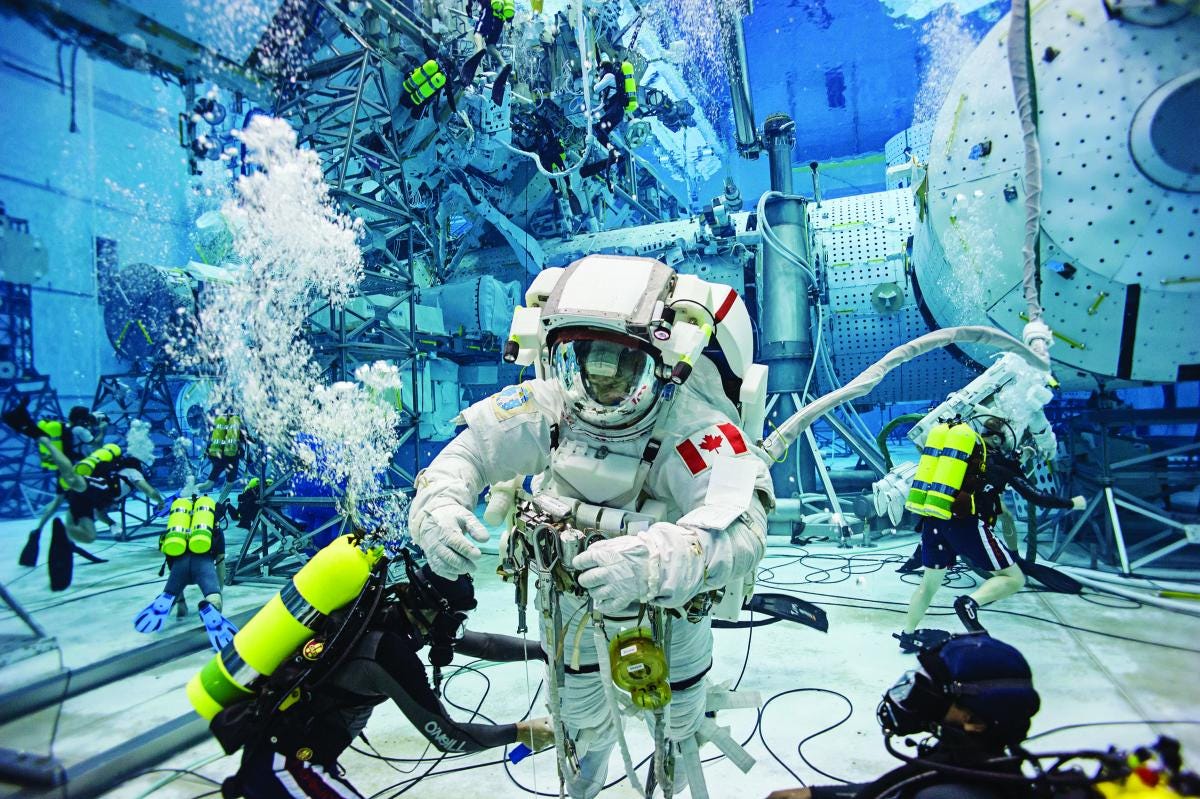
Before we set off for Mars, I want to spend some time answering a basic question: how do we select and train our current astronauts?
Spaceflight is not for the faint of heart. It is a job with a mortality rate similar to climbing Everest. I think it’s safe to say that astronauts will often represent the top 1% of people in any given metric: they are, generally, the smartest, healthiest, and fittest people on the planet. During selection, they are evaluated across a myriad of factors—decision-making, leadership, spatial reasoning, emotional intelligence, and teamwork, to name a few—but today, in order to keep a narrow focus, I’ll be primarily looking at the high-level qualifications that are needed to first become an astronaut, before moving on to the physical training required before, during, and after the mission.
This article will provide a brief overview of the history of astronaut selection, pre-flight training, and in-flight countermeasures, before discussing the state of the art. Without further ado, let’s begin!
Quick definitions:
Astronaut: a person trained, equipped, and deployed by a human spaceflight program to serve as a commander or crew member of a spacecraft. (Not just anybody who flies in space.)
Spaceflight countermeasures: strategies or technologies used to mitigate the negative physiological, psychological, or emotional effects experienced by humans during spaceflight.
Extravehicular activity (EVA): activity or maneuvers performed by an astronaut outside a spacecraft in space, wearing a spacesuit, usually for up to 8 hours at a time.
Note: this article is also very NASA-centric. Other space agencies—ESA, CSA, ROSCOSMOS, CNSA, JAXA, etc.—have their own selection methods, and both Russian and Chinese astronauts undergo their own in-flight countermeasure protocols, though a lot of the underlying requirements are the same.
A Not-So-Brief History
1958-1963: Project Mercury
Selection
When NASA was first established in 1958, there were no existing requirements of what an astronaut should—or could—be. The agency leaders knew that the role would be dangerous; it would require experience with high-altitude flight, comfort in small spaces, and good machine handling skills. The closest proxy at the time was the test pilot: a newly minted military person with extensive aircraft handling skills and courage that bordered on insanity. NASA knew they wanted to recruit from this cast of characters, and so their initial selection requirements were deceptively straightforward. Candidates had to be:
under 40 years old
under 5 feet 11 inches in height
1,500 hours of jet flight time
Of course, jet flight time was hard to come by for anyone who was not a trained military test pilot. Beyond these listed requirements, the Mercury astronauts’ main qualification was that they were “medically boring.” But because the candidates were exclusively from military backgrounds, I want to take a quick sidebar to describe the sort of physical fitness assessments the Navy and Air Force were using at the time, as a proxy for what sort of physical shape these individuals were in.
For instance, cadets at the US Air Force Academy in the 1960s had to meet the following requirements in their semiannual physical fitness test (PFT):
7 pull-ups
7 foot standing broad jump / long jump
30 push-ups
50 sit-ups in two minutes
1:50:00 600-yard run
By the late 1960s, the Air Force began integrating additional requirements designed by Kenneth Cooper, an Air Force Lieutenant Colonel and “father of aerobics,” who proposed using a person’s total distance run in 12 minutes as a proxy for overall aerobic fitness. The Air Force adopted Cooper’s test, requiring that all cadets be capable of running 1.5 miles in 12 minutes, starting in the 1970s.
This test does not signify much on its own, beside the fact that those who completed it could run an 8:00 min/mi pace for 1.5 miles. But, like the Presidential Fitness Test and other somewhat arbitrary all-around markers of physical fitness, it was a step function change in how we measured physical capacity.
Side note: I avoided looking at the history of Navy fitness requirements as they seemed less standard across the service, and were highly variable over the decades. Sorry Navy!
Pre-Flight Training
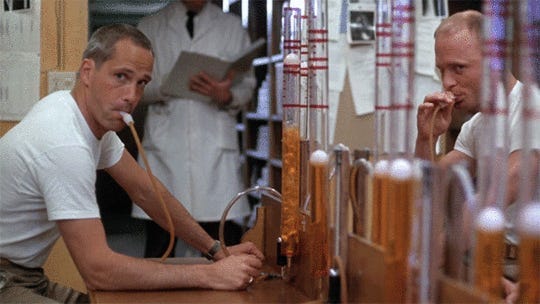
Basically, none. The strategy at this point was to select already fit astronauts and keep them healthy enough for space. A contemporary Popular Mechanics article actually addresses this directly:
The Astronauts have no formal program of either diet or exercise. When Project Mercury started, the astronauts were asked if they wanted regular calisthenics. Being experienced military men, they said "No" emphatically, and that was that….This is not to say that they don't keep in good physical condition. But as Scott Carpenter pointed out: "We don't need any formal health or physical conditioning program. We're big boys now, and know how to take care of ourselves. Besides, this thing is important to us, and we're not going to let ourselves get out of shape.”
This, it turns out, would be the tune of many, many classes of astronauts Generally, the requirement was that astronauts be healthy at selection, and stay healthy through their flight, with effectively no regimented fitness program while here on Earth.
In-Flight Countermeasures
None. The Mercury capsule was too small to do much inside the interior, and the flights were too short to require physical countermeasures beyond basic life support.
1964-1972: Gemini & Apollo
Selection
By 1964, Project Gemini was well underway, with Apollo on the horizon, and the requirements for astronaut selection were starting to change. While the Group 2 astronauts remained demographically similar to the original Mercury astronauts, the selection criteria for Group 3 relaxed the required jet flight hours from 1,500 to 1,000, and lowered the maximum age to 34 years old.
An additional emphasis was placed on academics: in the 1965 class, six “scientist astronauts” were selected from an application pool now cluttered with PhDs and MDs. These candidates still had to pass through the same physical testing as the test pilots selected during Mercury, with the “everything but the kitchen sink” style of medical testing to ensure that they, too, were medically boring.
Pre-Flight Training
Like the Mercury class before them, the astronauts that would go on to fly in Gemini and Apollo were trained in centrifuges, parabolic flights, and jet aircraft. However, there were still no set aerobic or strength training programs, except for the addition of “dry run” field tests that assessed their ability to walk, bend, lift, and carry in extravehicular activity (EVA) suits.
These changes reflected the new realities of spaceflight. During future missions, astronauts would have to spend multiple days in microgravity with little room to maneuver inside of their capsules, before being expected to perform extended spacewalks on the lunar surface. The Apollo-era surface spacesuits weighed approximately 200 pounds on Earth, and although that amounted to only ~30 pounds on the Moon, it was still additional, awkward mass for the astronauts to carry for up to 8 hours at a time. They had to practice walking around, picking up rocks, deploying scientific equipment, and climbing ladders. This marked the beginning of what would eventually become a very formalized part of astronaut training: EVA prep.
In-Flight Countermeasures
In order to combat what researchers were starting to understand as spaceflight-induced deconditioning, astronauts began to practice exercise countermeasures. At a high level, there were two primary goals with these countermeasures:
Mitigate the aerobic and muscular deconditioning that occurs in microgravity and poses a threat to crew health and safety
Ensure crew readiness for surface EVAs, in order to achieve the science goals of the mission
I want to emphasize this point because while they are related, those two objectives are slightly different. The first goal is focused on the immediate and long-term health of the crew, and the other is focused on the goals of the mission. Both will be important for future long-duration flights to Mars, but notably, slowing down bone density and muscle loss is inherently different than actively training crew for long days out on EVA.
The Gemini IV mission introduced the first in-space exercise equipment in the form of a resistance band, as part of the M-3 medical study. This study, together with the M-4 (the phonocardiogram), began to characterize the effects of spaceflight and EVAs on the cardiovascular system. Later Gemini flights would integrate these resistance bands into a more formal in-flight training protocol.
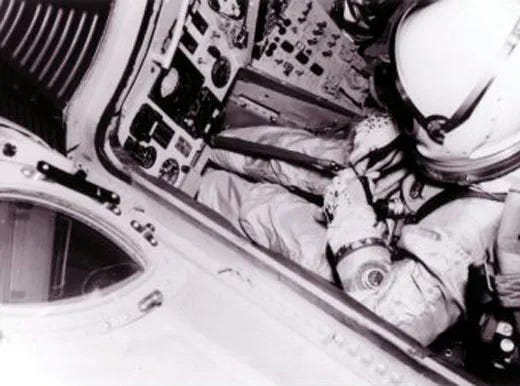
During the Apollo missions, NASA introduced the commercially developed “Exer-Genie” device, a compact rope-friction resistance device that allowed astronauts to perform a variety of exercises for 15-30 minutes, with varying success:
Mike Collins complained after his Apollo 11 flight, “If you got a good workout on the Exer-Genie, it got so hot that you couldn’t really touch it.” Pete Conrad was also frustrated by the device. He told NASA debriefers, “I tried after the Apollo 12 flight to learn how to use the Exer-Gym right. And I never did like it.”
Neil Armstrong added:
“[We] did a little bit of exercise almost every day. The Exer-Genie worked alright. It got a little hot and stored a lot of heat, but it was acceptable.”
1973: Skylab
Selection
The Skylab program often gets overlooked in the history of spaceflight. It’s kind of an “if you know, you know” era that resulted in a tremendous wealth of studies from only three missions lasting 28, 59, and 84 days each. Repurposed from the upper stage of a Saturn V rocket, the Skylab module was what I would consider to be America’s first space station. It was during this era that we made tremendous knowledge gains in space medicine that would later pave the way for the International Space Station.
Notably, NASA did not recruit a targeted class of astronauts for Skylab the way they did for Mercury, Gemini, and Apollo. Instead, they utilized the existing scientist-astronauts in the corps who 1) hadn’t flown yet, and 2) they thought would be a good fit for long-duration spaceflight.
Pre-Flight Training
Like Mercury, Gemini, and Apollo, Skylab had no regimented pre-flight exercise program. It did, however, introduce a set of pre-flight tests that established the astronauts’ baseline levels of performance and vitals during exercise. For Skylab 4, each crewman completed eight pre-flight baseline tests on the cycle ergometer, six of them spaced at roughly monthly intervals, so NASA could compare pre-flight, in-flight, and post-flight cardiovascular/metabolic responses.
We’ll dive into this below.
In-Flight Countermeasures
The Skylab program was hyper-focused on studying the effects of long-duration spaceflight on the human body. The dramatic increase in habitable volume provided enough space for the first large piece of exercise equipment: the stationary bicycle, or cycle ergometer. This was later complemented by the addition of a device called the “mini-gym,” which focused on isokinetic resistance exercises to preserve muscle strength.
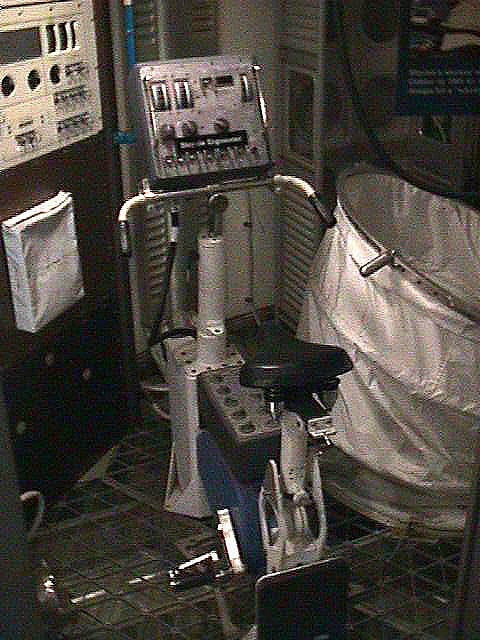
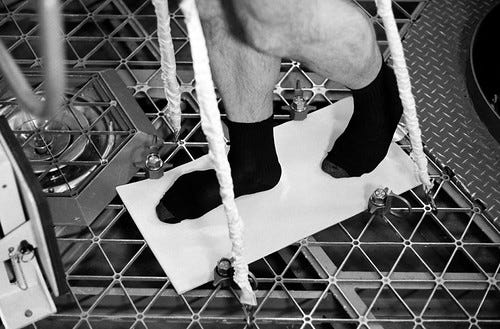
The first two Skylab missions showed that the cycle ergometer alone was not enough to maintain leg and back muscle mass and strength, so physician and support astronaut William Thornton designed a makeshift treadmill: a Teflon-coated aluminum plate bolted to the floor, with bungee cords attached to the floor to provide downward loading while astronauts walked or jogged in stocking feet. The crew nicknamed it “Thornton’s revenge” because it was so horrible. After each subsequent Skylab mission, the countermeasures evolved, and began to look a lot like our modern-day protocol:
Skylab 2: astronauts used the cycle ergometer for ~30 minutes per day. The ergometer was also outfitted with sensors and used for medical measurements.
Skylab 3: exercise time increased to ~60 minutes per day, and NASA added an isokinetic resistance device called the “mini-gym.” This marked the first integrated countermeasure approach where astronauts were expected to incorporate both aerobic and strength training.
Skylab 4: exercise requirements increased to ~90 minutes per day, and the crew added a treadmill-like device.
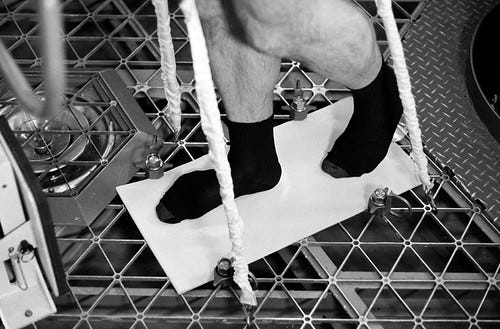
Thornton’s Revenge (Credit: NASA)
Electrical recordings of heart activity of each astronaut were also taken before, during, and after flight to determine changes in heart function that might have been caused by the long-duration flights. All told, Skylab laid the foundation for modern-day exercise countermeasures. The exercise regimen also had a notable effect on crew morale:
“It does make you feel good if you can work out twice a day.” [Pete Conrad’s] Skylab 2 crewmate Joe Kerwin added, “Even just running around [Skylab’s] ring lockers or throwing the ball around in the evening for 15 minutes makes you more relaxed.”
1978-2011: the Space Shuttle
Selection
In 1981, the first flight of Space Shuttle orbiter Columbia ushered in a new era of “routine” access to space. The Space Shuttle (“Space Transportation System” for my real ones in the back) was a spacecraft designed to launch like a rocket and land like a plane. Though the first flight wasn’t until ‘81, by the mid-1970s, the Shuttle program had already started to shift the selection criteria for NASA astronauts. With a crew capacity of seven and an original target cadence of 24 flights per year, the goal of the Shuttle program was routine access to space, and more importantly, lots of science.
In 1978, to ramp up for this new bus route to space, NASA selected its Group 8 astronauts, publicly referred to as the Thirty-Five New Guys—and privately as the fucking new guys—which was both their first class selected since 1967, and their largest, most diverse group to date. Among the class were the first six women astronauts, including Sally Ride, as well as the first African-American and Asian-American astronauts.
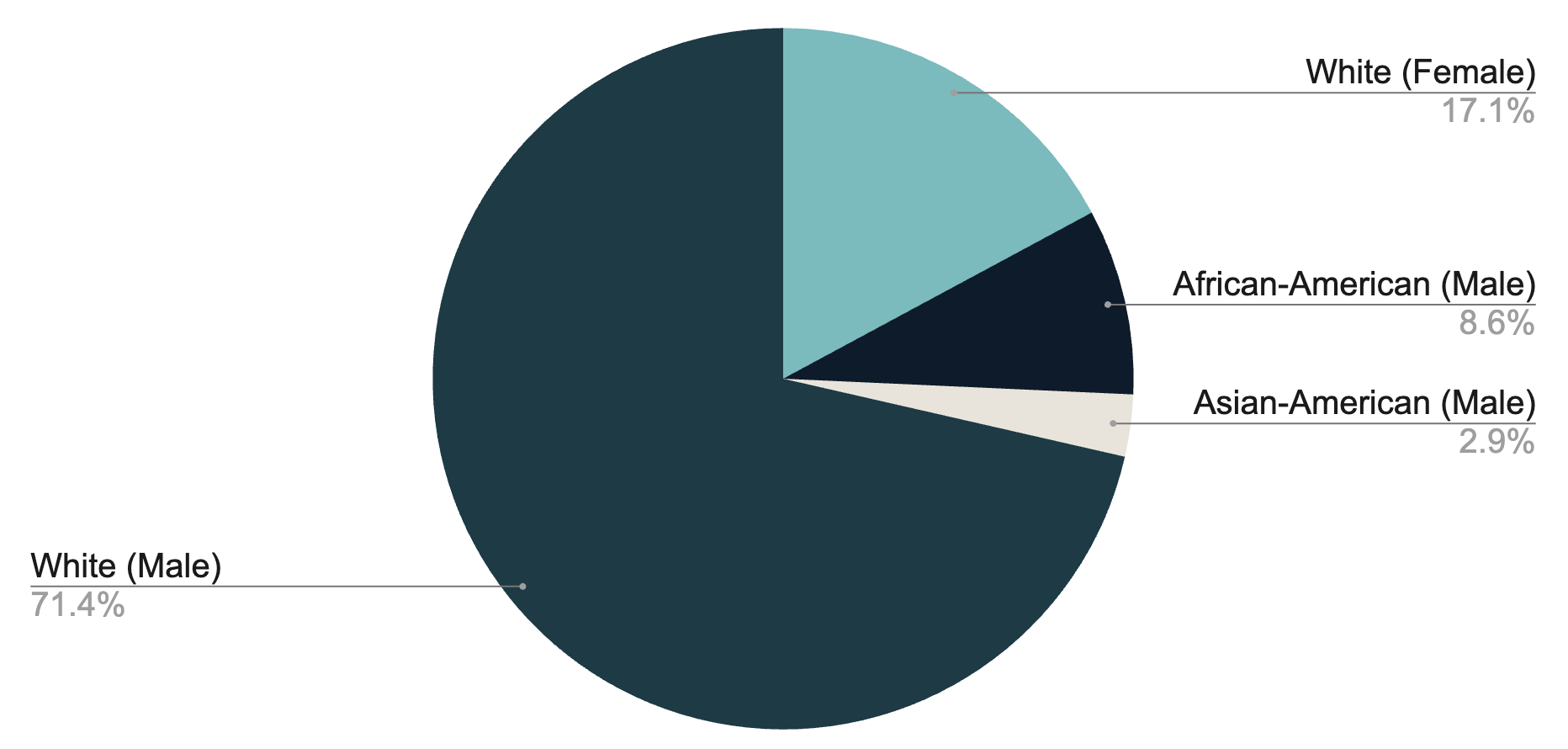
This class also introduced a new “category” of astronaut: the mission specialist. All told, the class consisted of 15 “pilot” astronaut candidates, who were all military test pilots, and 20 “mission specialists,” who were chosen for their scientific background rather than piloting ability. (Side note: several mission specialists were still from military backgrounds—they just weren’t test pilots.)
From 1978 on, NASA selected a new class roughly every two years, bringing in astronauts with a wide variety of backgrounds. Eventually, a third “category” of astronaut would be added: the payload specialist. These astronauts flew for a specific mission, with a specific payload, and were generally chosen by the research community, partnering organizations, or international institutions. They were not required to be US citizens, and were also exempt from specific requirements, like colorblindness. A summary of the physical requirements for the different astronaut types is included below:
Class I physical (pilots): 20/50 uncorrected vision correctable to 20/20, seated blood pressure ≤ 140/90, and height 5'4"–6'4"
Class II physical (mission specialists): 20/150 uncorrected vision correctable to 20/20, seated blood pressure ≤ 140/90, and height 4'10.5"–6'4"
Class III physical (payload specialists): created specifically for the role, basically “medically boring”
Pre-Flight Training
Like the spaceflight eras before it, the Shuttle era had no strict PFT-style physical fitness exam or regimented physical training that astronauts were required to perform each day. However, they were once again expected to stay in good physical shape, train in pressure chambers and parabolic flights, maintain aircraft readiness, and, if assigned EVA work, spend up to 10 hours a day rehearsing in neutral buoyancy.
To ensure readiness for these underwater training hours, NASA required that all astronauts be SCUBA-certified and receive military-style survival training. Shuttle astronauts had to be able to swim 3 lengths of a 25-meter pool without stopping, in a flight suit and tennis shoes, and tread water 10 minutes.
In-Flight Countermeasures
Compared to the months spent onboard Skylab, Shuttle missions were relatively short—on the order of 9-14 days. As a result, though NASA had learned a lot during the Skylab missions, the focus for Shuttle astronauts was on maintaining aerobic conditioning and post-flight functional readiness, rather than fighting off an existential threat to their bone and muscles.
Still, the Shuttle flight rules called for exercise no less than every other day for the Commander, Flight Engineer, and Pilot, and every third day for payload and mission specialists. Depending on the mission, the crew would utilize either a cycle ergometer, a treadmill, or rowing machine to get their workout in.
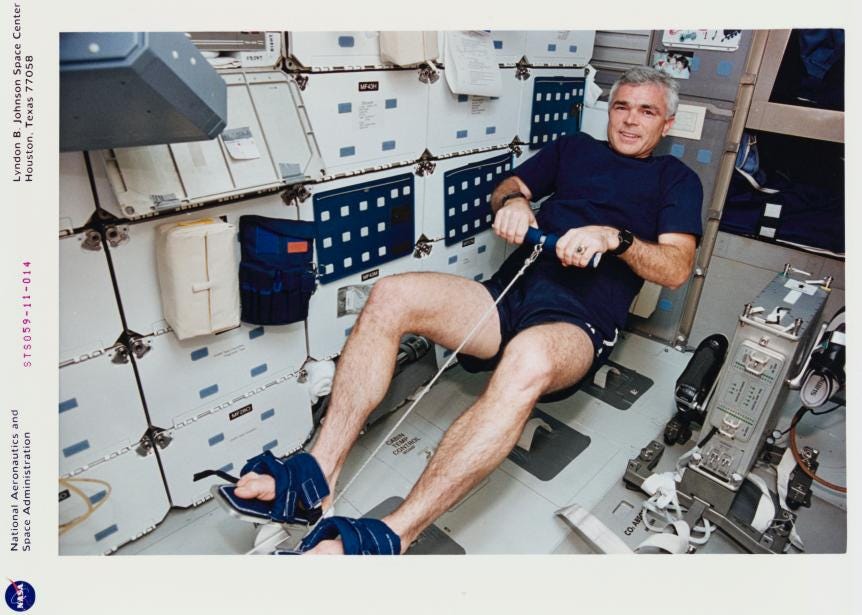
The Shuttle orbiter was also significantly smaller than Skylab; it also hosted more than double the crew. As a result, space was quite limited. NASA introduced yet another resistance band to help astronauts maintain their strength:
"We took a large rubber band—called a Dyna-Band—that we used for exercise and stretched it across the airlock hatch on the mid-deck. Then we’d shoot ourselves down the tunnel. One of the crew members would shoot you down, and we had a competition to see who could do it without touching the tunnel walls. Nobody ever made it."
Astronauts Today: ISS and Artemis
Selection
Over time, NASA’s requirements for astronaut selection have changed incrementally from only allowing military test pilots towards accepting a broader set of civilian scientists. The start of the 21st century further accelerated this change with the launch and assembly of the International Space Station (ISS). Since 2000, the ISS has been continuously occupied with astronauts, who spend anywhere from 3 months to a year in space performing all manner of work and research. This article will focus on both ISS and the ongoing Artemis program as our “state of the art” of how astronauts are selected and stay fit in space.
Today, in order to be considered for NASA’s astronaut program, you must:
Be a U.S. citizen
Possess a master’s degree in a STEM field, including engineering, biological science, physical science, computer science or mathematics, from an accredited institution. (Note: this higher-ed requirement was a new addition in the 2020s)
Have at least two years of related professional experience obtained after degree completion or at least 1,000 hours pilot-in-command time on jet aircraft.
Be able to pass the NASA long-duration flight astronaut physical.
I’ve bolded the last part, because once again, there is no real physical “entrance exam” the way there has been for the military academies or armed forces. You don’t have to do a set number of push-ups, or pull-ups, or run 1.5 miles in 12 minutes. There is, however, extensive lab work, medical exams, and cardiovascular tests—including colonoscopies, MRIs, cardiopulmonary tests, breast exams, thyroid checks, prostate exams, and psychiatric evaluations. NASA wants to ensure that their astronauts are in good shape, and likely to remain healthy for missions of up to a year.
Notably, we’ve also continued to see the shift in astronaut demographics that started in the Shuttle era, with women on average making up ~50% of each modern astronaut class. Unfortunately, in the grand scheme of NASA astronauts, we still aren’t close to parity.
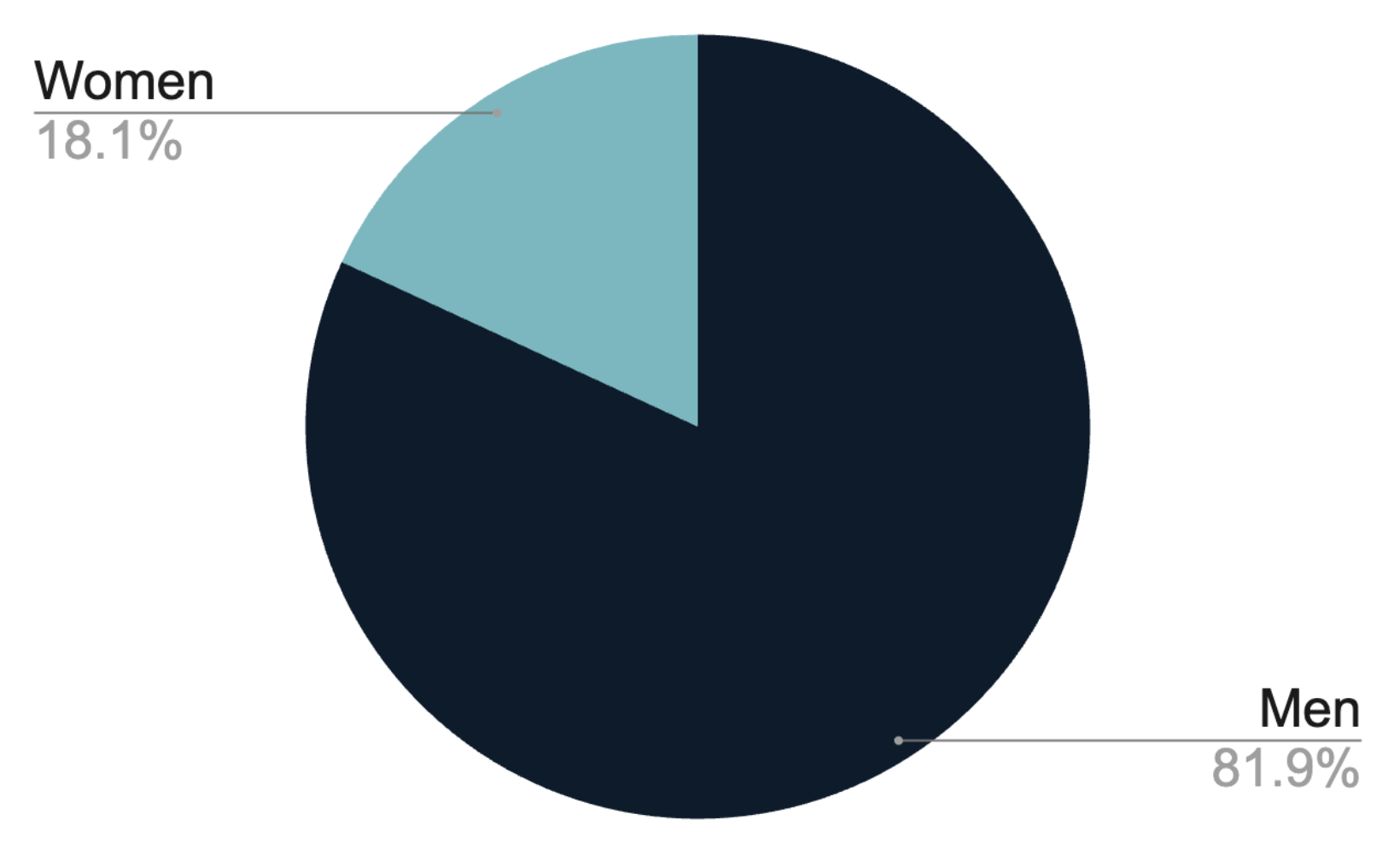
I’m including these numbers primarily to make a belabored point: both in spaceflight and in sports, we need more data on women. A lot of what we know about exercise physiology and training is historically based on men—and a very specific type of man. I also want to make it clear that I don’t think women are so different physiologically that we require special handling, because that argument feels like it’ll set us back multiple waves of feminism, or result in us once again shortening women’s races or limiting women’s potential. I do, however, think we’re leaving gains on the table when we don’t do our due diligence in study recruitment or investigate physiological differences.
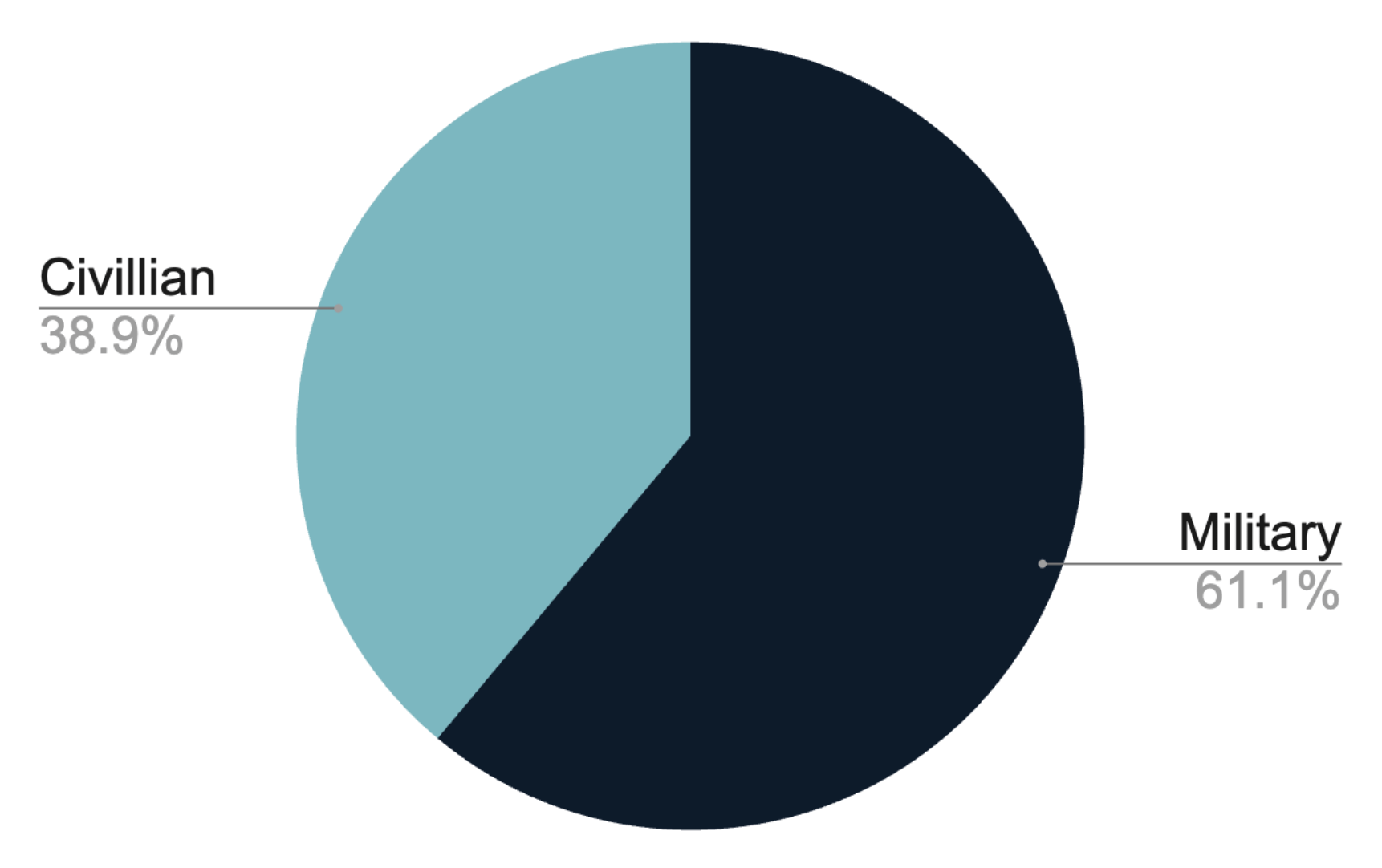
In recent years, NASA has been selecting astronauts for a multi-mission exploration campaign: ISS, Orion, lunar surface EVAs, and eventually Mars. In the last two classes, we’ve actually seen a swing back to more test pilots in each cohort. The reason for this is simple: we are flying new vehicles again! With the Orion capsule and future lunar landers, NASA will prioritize recruiting and training pilots with test backgrounds until they, too, become routine vehicles.
We’ve also seen a pivot towards geologists and engineers with oil or mining backgrounds. NASA is placing a heavy emphasis on in-situ resource utilization on the Moon, which means that astronauts will not only have to do geology, but may need to set up, operate, and maintain heavy equipment that will turn water ice into hydrogen and oxygen for life support and rocket fuel.
Pre-Flight Training
I said there was no physical fitness “entrance exam” to become an astronaut. While that’s true, there are now what NASA calls “fitness for duty” requirements: effectively, criteria for what sort of shape you need to be in before embarking on a long-duration mission aboard the ISS.
This pre-flight protocol is much more formal than Mercury, Gemini, Apollo, or even Shuttle. NASA astronauts now undergo preflight tests to establish baselines in aerobic fitness, agility, strength, and endurance, which help specialists customize exercise plans. Notably, astronauts also have specific strength exercise requirements listed in the NASA-STD-3001:
Minimum strength: Deadlift 1.0 × body weight, bench press: 0.7 × body weight
Microgravity EVAs: Deadlift: 1.3 × body weight, bench press: 0.8 × body weight
Surface EVAs: Deadlift: 1.6 × body weight, bench press: 1.0 × body weight
This means that astronauts must meet the above requirements before launch in order to ensure flight readiness. I do want to note that these strength requirements are also not very high—a bodyweight deadlift is a meaningful functional floor for a healthy adult. The minimum strength requirements effectively screen an astronaut’s ability to lift themselves up and perform an emergency egress. At 1.6 x bodyweight, the surface EVA deadlift requirements (not to mention the 1.0 x body weight bench press) is a true training standard—most adults would not casually meet those requirements, and so most astronauts would require some sort of pre-flight lifting protocol.
In-Flight Countermeasures
In the ISS era, there are four primary requirements driving exercise countermeasures:
In-Mission Aerobic Capacity: NASA-STD-3001 Volume 1, Rev B requires crewmembers to maintain their aerobic capacity at or above 80% of their pre-mission values.
In-Mission Skeletal Muscle Strength: Countermeasures shall maintain in-mission skeletal muscle strength at or above 80% of baseline values.
Microgravity EVA Aerobic Capacity: to ensure EVA readiness on the ISS, crewmembers shall maintain an in-mission VO₂ max at or above 32.9 ml/min/kg for missions with microgravity EVAs as determined by either direct or indirect measures.
Surface EVA Aerobic Capacity: Crewmembers shall maintain an in-mission VO₂ max at or above 36.5 ml/min/kg for missions with extraterrestrial surface EVAs as determined by either direct or indirect measures.
On ISS, there are no surface EVAs; on Artemis, future lunar EVAs will drive that fourth requirement.
Currently, the ISS aerobic training protocol is focused on interval or steady-state exercise on either CEVIS (the cycle ergometer) or T2 (the treadmill). CEVIS work rates are developed from the astronaut’s preflight VO₂peak test and prescribed around 70–100% VO₂peak, while T2 treadmill sessions are prescribed around 70–100% of maximum heart rate. Basically, they’re doing a lot of HIIT. Currently, on the ISS, astronauts are required to spend ~30 minutes a day performing aerobic exercise, and 30-60 minutes of resistance training, for a total of 2.5 hours “exercising” with setup and cleanup.
For Artemis, this looks a bit different: space and mass constraints mean that the Artemis 2 crew only had access to the rowing machine for ~30 minutes each day. For a ~8 day mission, this is fine, but won’t be nearly enough for Mars.
Looking Towards the Future, and Mars
Spaceflight countermeasures have come a long way since the Mercury-era days, where astronauts were essentially going off vibes, or even the Apollo-era Exer-Genie. Skylab, Shuttle, and ISS together helped NASA understand the effects of long-duration spaceflight, and build compact, effective equipment to help mitigate the worst of the effects. With ~2 hours a day of combined resistive and cardio exercise on the ISS, astronauts have remained fit for duty, though with noticeable long-term effects on bone density and spine health.
However, here’s where I get in trouble with flight surgeons: 30 minutes of cardio 6-7 days a week is not a lot. Whenever I say this, space medicine folks get grumpy and reply, “but it takes them 2 hours!” as though there aren’t a ton of athletes here on Earth exercising for 6-7 hours each day.
I know astronauts are not professional athletes. They have other things they need to be doing in space, like science and fixing toilets. But in microgravity, daily movements—walking, lifting, supporting your own torso—no longer require the same level of cardiovascular or muscular output. Without omnipresent gravity, astronauts’ hearts need to work far less hard to pump blood “uphill,” or recruit as many muscles to move their limbs around or stabilize their bodies.
So, yeah, 30 minutes is not a lot of cardio. Those tiny movements you do throughout the day—walking, pushing open doors, moving your hands while you talk, climbing stairs—all add up. In microgravity, astronauts are effectively detraining. On the way to Mars, they’ll have 7-9 months of microgravity exposure before entry, descent, and landing, after which they’ll be expected to perform EVAs in a 300 pound suit at ⅓ of Earth’s gravity. They’ll be weaker than when they left Earth, aerobically deconditioned, and at a higher risk of bone fracture.
This begs the question: what would happen if we did train astronauts like true elite athletes? What if we gave them multiple, targeted sessions each day? Could we keep them fit for Mars? We’ll explore this next time!
Thanks for reading!
Further Reading
“Historical Evolution of Astronaut Selection –.” Accessed: May 22, 2026. [Online]. Available: https://www.spacesafetymagazine.com/space-exploration/astronaut-cosmonaut/historical-evolution-astronaut-selection/
J. C. Miller, R. D. Shadduck, and K. G. Cornum, “Physical Fitness Testing by the U.S. Air Force Academy, 1955-1981:,” Defense Technical Information Center, Fort Belvoir, VA, Sep. 1983. doi: 10.21236/ADA134524.
National Aeronautics and Space Administration, “Training for space: Astronaut training and mission preparation,” NASA Johnson Space Center, Mar. 2006, FS2006-03-011-JSC
“Astronaut Fact Book - NASA.” Accessed: May 22, 2026. [Online]. Available: https://www.nasa.gov/reference/astronaut-fact-book/
D. Francisco, “NASA Space Flight Medical Selection, Recertification and Mission Evaluation Standards”, National Aeronautics and Space Administration Office of the Chief Health and Medical Officer, Sep. 2024, OCHMO-STD-100.1A
“Astronaut Requirements - NASA.” Accessed: May 22, 2026. [Online]. Available: https://www.nasa.gov/humans-in-space/astronauts/astronaut-requirements/
“Project Mercury Overview - Astronaut Selection - NASA.” Accessed: May 22, 2026. [Online]. Available: https://www.nasa.gov/history/project-mercury-overview-astronaut-selection/
S. D. Taoufik, K. M. Coffey, and D. R. Francisco, “Astronaut physiological deconditioning and exercise prescription countermeasures in spaceflight”. National Aeronautics and Space Administration, NASA-STD-3001, 2025
K. Burkhart, B. Allaire, D. E. Anderson, D. Lee, T. M. Keaveny, and M. L. Bouxsein, “Effects of Long-Duration Spaceflight on Vertebral Strength and Risk of Spine Fracture,” J Bone Miner Res, vol. 35, no. 2, pp. 269–276, Feb. 2020, doi: 10.1002/jbmr.3881.
R. D. Seidler, X. W. Mao, G. D. Tays, T. Wang, and P. Zu Eulenburg, “Effects of spaceflight on the brain,” Lancet Neurol, vol. 23, no. 8, pp. 826–835, Aug. 2024, doi: 10.1016/S1474-4422(24)00224-2.
G. D. Tays et al., “The Effects of Long Duration Spaceflight on Sensorimotor Control and Cognition,” Front Neural Circuits, vol. 15, p. 723504, 2021, doi: 10.3389/fncir.2021.723504.
S. Shibata et al., “Cardiac Effects of Long-Duration Space Flight,” J Am Coll Cardiol, vol. 82, no. 8, pp. 674–684, Aug. 2023, doi: 10.1016/j.jacc.2023.05.058.