

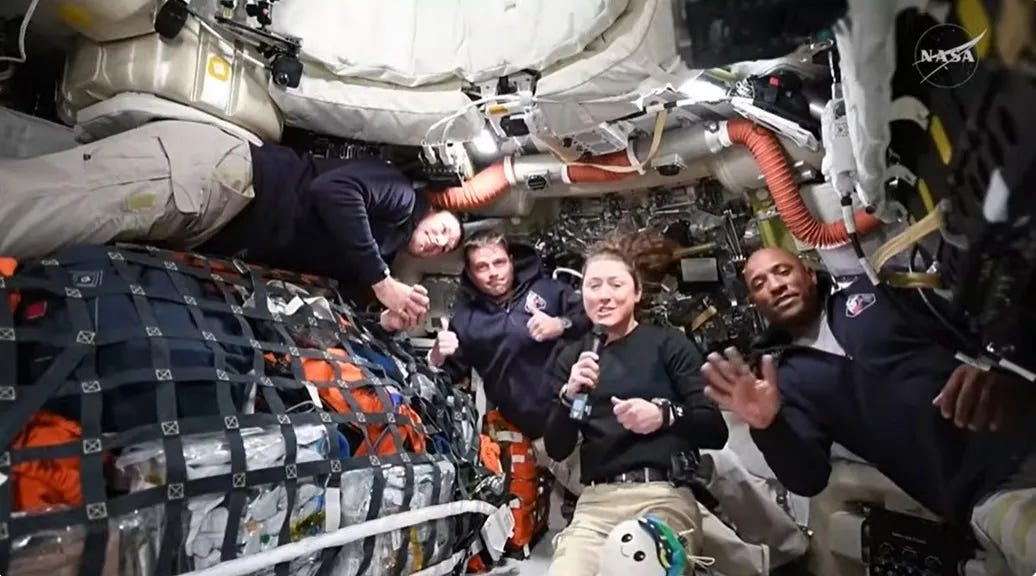
At 6:35 pm on April 1st, 2026, four astronauts lifted off from Cape Canaveral to begin a ten-day journey around the Moon. This was not an April Fool’s joke—this was NASA’s Artemis II mission, a key step in a series of missions that will utilize the Lunar surface as a proving ground for technology that will one day enable future missions to Mars. So far, the mission has been a fantastic success. The Space Launch System went off without a hitch, and the Orion capsule is being put through its paces. After only one minor hiccup involving the new space toilet, the crew once again has a working plumbing system, and is on their way to the Moon. Ad astra!
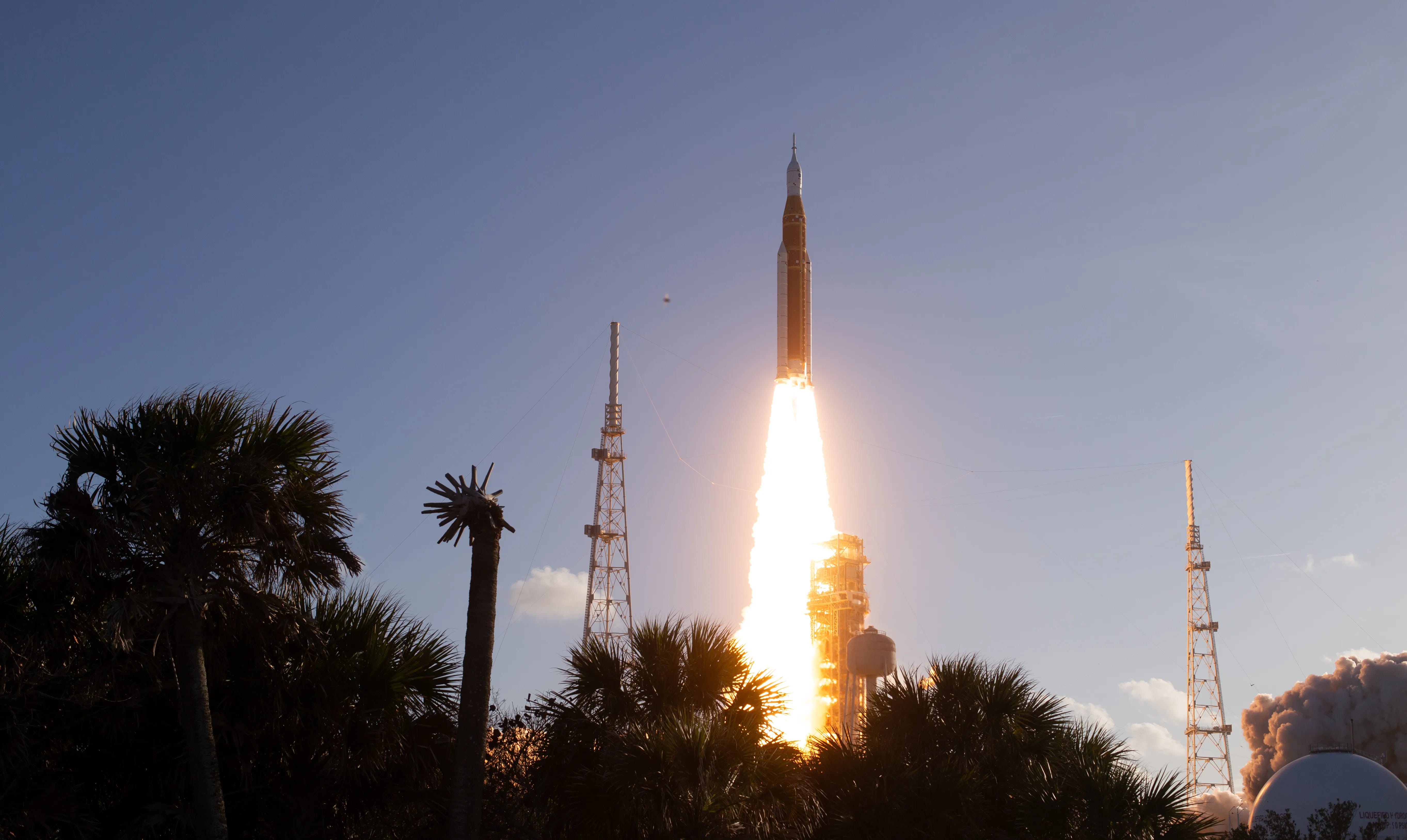
But in the few days since the launch, I’ve heard a lot of chatter—both online and in real life—from folks who are surprised to learn that we are sending people back to the Moon. A lot of these people are not in the aerospace industry, and so I don’t really fault them for not being up to date on all the spaceflight news. Admittedly, the launch also snuck up on me, an actual aerospace engineer. But we are going to the Moon! For the first time in fifty years! Why didn’t people know about it? Why aren’t they more excited?
When I started having these questions, I thought back to a pivotal moment in college, when a teammate of mine asked if I was excited to “see the Moon shuttles” at the Kennedy Space Center during our annual winter training trip to Florida. This friend wasn’t an off-grid hipster; she was a real MIT student who has now gone on to receive an MD/PhD. She is not stupid. She will probably cure some sort of kidney disease someday, and will definitely make more money than me. But in college, she genuinely believed NASA’s Space Shuttle was the spacecraft that took people to and from the Moon, and it did this for decades. She also believed that NASA “no longer existed” after the Space Shuttle stopped operations.
This stood in sharp contrast to older adults I knew, who could all tell you exactly where they were when Neil Armstrong took that one small step for Man onto the Sea of Tranquility. That college interaction planted a seed of doubt in my mind: if a STEM-oriented college student didn’t know what was happening at NASA, what did the average American think? And, more importantly: how do we, as scientists and engineers, better communicate with the public?
This question, which has been on my mind for a long time, has only been exacerbated by the latest launch. So, I want to spend some time unpacking what I think are the big challenges for communicating about spaceflight specifically, and in our current media landscape more broadly. This article is mostly musings, and a bit of a rant. With that said, let’s begin!
Non-Space Factors
Algorithmic Fragmentation & the Death of the Monoculture
My first instinct, when considering why it is so hard for NASA to communicate with the general public, is to blame it on our media environment. This phenomena has many names: the algorithm, information silos, the death of the monoculture. It is most apparent to me when I visit my 90-year-old grandmother, who still watches the evening news on TV. Frankly, I find it refreshing: the six o’clock news comes on, I get 30 minutes of The Horrors, and then we have dinner and watch Jeopardy. Sometimes, the CBC also throws in something delightful—a new vaccine development, or a surfing parrot—and I feel like I actually get a decent sample of different stories along with some optimism, because the Big News Channel is tailoring the roundup for an entire population, rather than an individual.
This is in contrast to the way I usually get my news: on my phone, through an app, which I’m convinced is just learning from the stories I read and regurgitating more of the same content back at me. It’s similar to when you buy something on Amazon, like a ladle, and then get a thousand recommendations for ladles. I don’t want another ladle; I just bought one. Likewise, I actually don’t want my news tailored to what I most recently read, or even my interests. I want a sampler of relevant stories, curated to me by journalists and media professionals, whose job it is (should be?) to do actual reporting, rather than push out sensationalized coverage of hot-button issues. Is that too much to ask for?
From where I’m sitting, it seems like the only way to break through in this kind of media landscape is to find a way to sensationalize a space mission—whether it be through a culture war, some sort of broader geopolitical strategy, or scandal—and frankly, I’m not really interested in doing that. Maybe that’s what Apollo had—maybe the Cold War was enough to make an entire nation tune in when Neil Armstrong stepped off that ladder, and it wasn’t about exploration, after all. But when I’ve spoken to folks who remember the first Lunar landing, they don’t say, “thank God we beat the Soviets.” They remember the feeling of awe, and pride, and inspiration. And I’d like to believe that’s worth tuning in for.
I don’t really have any tangible solution to this; to my knowledge, NASA is doing all the right things. They’ve got a YouTube channel, Instagram, TikTok, and all the other socials. They do outreach and activations. They have a plethora of free educational content all over their website, with activities and stories made for students, parents, and educators. I legitimately do not know what I would change, from their side. The problem, I think, lies with us—the fault, dear Brutus, is in our media diet. If anyone has a solution, let me know!
The World Kind of Sucks Right Now
This one doesn’t need too much explaining. There is a lot of bad news, and the actual news cycles themselves are shorter than ever. In addition to everyone becoming increasingly siloed in where they actually obtain their information, we are also now faced with a veritable onslaught of horrors on a daily basis, leading many people to feel like they need to care about everything, all the time.
I’m not above it. Each morning, I open my news app on my phone and cringe through a few articles, compartmentalizing like there’s no tomorrow. Last year, in a bid to move more offline, I finally deleted Instagram—a change that has vastly improved my mental health, but also left me in the dark about a lot of organizations, events, and industry news that I care about. I’m still struggling to strike the balance between staying informed about issues I care most about while staying mentally sane.
With this current news landscape—with our nation at war, with corruption in our government, with civil liberties and government agencies seemingly being dismantled overnight, not to mention international conflicts and the rise of authoritarianism—it can be difficult to care about something as esoteric as sending four humans to a dusty rock. But “living through unprecedented times” doesn’t explain why people aren’t as tuned into a Moon mission, because this was true during the Apollo era, too. The first Lunar landings occurred at the height of the Civil Rights movement and US military involvement in Vietnam. In fact, the pushback against the space program of the 60s and 70s is quite well-documented in both historical news and art—see also the spoken-word poem, “Whiteys on the Moon.”
And so in a head-to-head, I blame media fragmentation over the abundance of horrible news as the primary factor driving this lack of public engagement (though I will admit, they are related). Without centralized news sources, there is simultaneously more and less curation—you’re lost in the sauce of your own algorithmic preferences. This leads to both a feeling of overwhelm and shallow engagement, and can make it hard for an agency like NASA—which if often touting unpolarized, somewhat esoteric news—to break through the noise.
Space Factors
There are, of course, some innate problems with the space industry, and human spaceflight missions in particular. This is the part of the article where I try to look in the mirror and dissect all the ways in which our industry still has room to improve. A lot of these are not inherently communication problems—a lot of these factors are instead rooted in policy or politics, but still have trickledown effects in how spaceflight work gets disseminated. In no particular order:
Artemis is Confusing
Artemis is a weird program. I won’t go into all the details, but human spaceflight has a decades-old history of what I would call commitment issues. Back in 2005, President George H. W. Bush launched the Constellation Program, with the goal of returning to the Moon “no later than 2020.” In 2010, President Obama cancelled Constellation (thanks, Obama!) after a review revealed that the program was massively over budget and behind schedule (fair). The agency pivoted to an asteroid redirect mission, and then scaled down to focus on commercial partnerships, which ultimately left it with a legacy of half-completed projects.
Orion, the capsule that the Artemis II crew is currently riding around the Moon, originally started development in the Bush administration, in 2005. It was supposed to be launched on the Ares I and Ares V rocket, which would return humans to the Moon. When the Obama administration cancelled Constellation, there was immediate pushback from Congress—and in particular members from states with major NASA facilities and aerospace contractors, like Texas, Florida, and Alabama—who argued that we needed to maintain American launch capabilities after the retirement of the Space Shuttle. This push has led the SLS program to be called many things: a jobs program, the Senate Launch System, a dumpster fire, but the fact remains that it did eventually lead to a rocket capable of getting us to the Moon. Huzzah!
But in part due to these unclear objectives and unstable objectives, NASA wanted to put their program eggs in some additional baskets, which is how we got the SpaceX Dragon and Falcon as part of the Commercial Crew Program, and now Starship and Blue Origin’s Blue Moon lander (among others) as later parts of the Artemis architecture. With all these players on the board, the Artemis program became a sub-optimal recycling bin of ideas. It kind of feels like NASA had to respond to a series of changing objectives, which eventually settled on “go back to the Moon,” and then had to look int he broom closet to see what sort of technology we had available to make it happen. Broadly, these issues fall under the umbrella problem I call, “too many cooks.”
In short, the Artemis program has suffered from too many cooks with commitment issues, which has led to a confusing narrative for the public to follow, and lots of broken promises. Not great for communication.
The Normalization of Spaceflight
In the 1960s, spaceflight was new—it was exciting, and it was dangerous. The decade was full of firsts: the first human in space, Yuri Gagarin, and the first American, Alan Shepherd; the first woman, Valentina Tereshkova, and the cascade of first spacewalks, rendezvous, and maneuvers that followed, all of which eventually culminated in the first Lunar landing in July of 1969. Through the decade, the space race was framed as a high-stakes drama, a battle with the Soviet Union for technological and idealogical superiority.
Now, once again, I’m not suggesting that we should sensationalize our space program to get more views, though many have, and are—this time, as a race against China. But I do think that to some extent, space exploration is suffering from success. The Shuttle program saw an order of magnitude shift in the number of astronauts NASA was able to fly in any given time. For the first time in history, we were flying scientists and engineers alongside test pilots. This led to a natural democratization: we saw the first class of women, along with the first Black and Asian and Hispanic astronauts. Suddenly, the space program began to look more diverse.
But a strange side effect of this shift to “operations” from “exploration” was that spaceflight became routine. People stopped tuning in for every single launch. They probably couldn’t name all the astronauts; there were dozens in the corps at any one time. It was only during disasters—after Challenger, and then Columbia—that people tuned in; that they were reminded, once again, that this is dangerous.
To be clear: I want spaceflight to be routine, and I don’t want it to be dangerous. Right now, the fatality rate for spaceflight per mile is less than automobiles, planes, and trains; per trip, it is comparable to climbing Mt. Everest. But “we”—as a species—have climbed Mt. Everest. We’ve been to the Moon. When things are no longer the first, they feel a bit less monumental. And as they become less dangerous, they become less sensationalized. But that doesn’t make them any less important.
The Katy Perry of It All
I’m not actually going to blame this all on Katy Perry. She’s taken enough strays in the debate over space tourism, and I think at the end of the day, her New Shepherd flight (NS-31) was neither the feminist slam-dunk nor the herald of the end times that everyone thought it was. I think, ultimately, it was just some rich people doing rich people things in a somewhat tone-deaf manner, but the resulting discourse overshadowed a lot of actual cool science that was happening on that suborbital flight.
As a result of our polarized media environment, sensationalized and controversial stories are the ones that break through. A hard truth for me to learn was that most people knew when Katy Perry went to space, and had something to say about it—even though they probably didn’t know or care that we were about to people back to the Moon. It’s hard to beat the allegations of spaceflight seeming like a waste of money when billionaires are profiting off of exploitation and then using that wealth for ten-minute suborbital joy rides in very phallic rockets. I just don’t really have a good defense for that.
Like I said above, I don’t want space programs to have to create controversy or drama to get views. I believe science should stand on its own, and I hope that most people recognize the difference between space tourism and professional astronauts. But billionaires are part of the space industry now, and so NASA’s communications teams have to work overtime to keep the public’s attention.
Now What?
So, what do we do about it? I’m not really sure. If you care about spaceflight, talk to your friends about Artemis! Follow along with the astronauts’ journey. Sign up for newsletters. Learn about all the ways in which spaceflight technology has been spun off for the benefit of Earth. Write to your representatives, and tell them that you’d rather fund science than war. Like, comment, and subscribe to NASA accounts—engage in content you’d like to see more of, in any way you’re able. And continue to pass that curiosity along—we could all use some optimism and inspiration right now.
To the Moon!
FAQ:
Now that I’ve gotten to say my piece, I wanted to quickly go through some frequently asked questions that I get regarding human spaceflight. These include, but are not limited to:
Q: We still send people to space? I thought NASA got cancelled in 2011 when the Space Shuttle stopped flying?
A: The Space Shuttle did indeed stop flying in 2011, after 30+ years of near-continuous fleet operations. For much of the 2000s and 2010s, NASA’s robotic missions took center stage: in 2004, twin rovers Spirit and Opportunity touched down on the Red Planet, and became instant sensations. This was followed up with Curiosity, which saw the first successful use of the Sky Crane technology, which to date is one of the coolest things we’ve ever done, as a species. Last, but certainly not least, we sent the follow-on rover Perseverance, which also included the first flight of a tiny, autonomous helicopter on another planet. But that’s not all—we sent Juno to Jupiter, and New Horizons to Pluto. We launched and deployed the James Webb Space Telescope on the far side of the Moon. And, perhaps more importantly, humans have been continuously living and working in space aboard the International Space Station for over twenty years!! The last time all the humans were together on Earth was in 2001! That’s crazy! Bottom line is that even without a flagship launch program like Shuttle, NASA has been doing things this whole time, often on a shoestring budget.
Q: Why are we sending people to space, when we could be using that money to solve climate change (or build affordable housing, or do X, Y, or Z…)?
A: My short answer to this is that I firmly believe we, as a species, can learn to walk and chew gum at the same time. To elaborate—we can and should care about improving life for people here on Earth at the same time that we are putting resources into exploration and discovery. To answer in more detail, I also believe that our society’s most pressing issues—affordable housing, crumbling infrastructure, climate change, the erosion of democracy—are more about policy and politics than they are about technology. I.e., throwing money at these problems is not enough. We can’t simply take the money getting funneled into ‘space’—more specifically to NASA, its infrastructure, and people—and funnel into a ‘climate change’ bucket, and expect the problem to disappear overnight. I actually do think NASA does more to fight climate change than people realize, but I’ll save that for another time.
I also want to put some of these costs in perspective. Yes, spaceflight is expensive. But right now, NASA's budget represents about 0.35% of the total federal budget for fiscal year 2026; for context, the Department of Defense (War?) takes about 20%. Current estimates put the cost of the ongoing war in Iran at $1-2b per day. That’s an entire Curiosity rover, or two Juno missions—from concept development to operations, including salaries, hardware, overhead, launch, and decommissioning over the course of 10+ years—every single day. Another example: recently, Kristi Noem spent more than $200m of taxpayer dollars on an ad campaign for the Department of Homeland Security. For that same amount of money, NASA sent the Stardust spacecraft through the tail of a comet, and returned a sample back to Earth. What!! That’s a way better return on investment, if you ask me.
And I know you may be thinking: those missions all seem like bargains, but they’re robots! Human spaceflight is way more expensive! And you’re right—the International Space Station has racked up an estimated cost of ~$100b over its thirty years of design, development, and operations. But that cost wasn’t just on the US—it was split among the 15+ involved countries, and contrary to popular belief, we are not just launching bags of money into space. The ISS is a national laboratory that conducts research in material science, biology, astrophysics, Earth science, and more, which have enabled scientific breakthroughs that have real consequence for people here on Earth. Just a few months ago, the FDA finally approved a new chemotherapy drug that was developed through research on the ISS. The original formulation of this drug required cancer patients to spend multiple hours in a clinic to receive the infusion. Now, it can be delivered as a single injectable in less than a minute, reducing cost and greatly improving patients’ quality of life. All because of research done in space.
Q: Why are we going back to the Moon? Haven’t we been there already?
A: There are a lot of factors that contribute to NASA’s overarching programmatic goals, and I’m not going to pretend like all of them are noble. Geopolitics and nationalism has a non-negligible amount of influence on agency priorities. However, I do actually agree with the overall premise of using the Moon as a proving ground for future missions to Mars. The Moon is also interesting in its own right.
To that end, it’s worth level-setting what we actually did on the Moon during the Apollo era. From 1969-1972, twelve men walked on the Moon at six different landing sites, most of which were mares, or ancient lava flows. Cool! But all told, even with the sweet Lunar rover, astronauts were only able to cover a couple dozen square kilometers, most of which were near the Moon’s equator. The Artemis missions are slated to land at the Lunar poles, which are significantly more interesting. First and foremost, they probably contain water. We can do a lot of cool things with water, like live, and also create rocket fuel—again, a key technology for future missions to Mars, which may rely on in-situ resource utilization to refuel on the Red Planet. The polar regions of the Moon are also kind of secretive, as the lighting conditions and crater impacts make it difficult to tell what’s going on down there from pictures alone.
Spot on. Similar issues here in Europe. I can only also advise people to subscribe to ESA’s channels! See here https://www.esa.int/ESA/Connect_with_us/Connect_with_us
Thanks for this excellent piece, Annika! One of the defining moments of my elementary school years was watching the Challenger explosion live on television in Mrs. Moore’s classroom. And the incredible shock, sadness, and disappointment that followed. To my young mind, with dreams of spaceflight on regular rotation, it marked a sudden end to the wonder and the glory of NASA. I wasn’t sure if it would ever recover. Then this past week, that excitement that dominated my early childhood was back. Maybe we can recapture that thrill and make space exploration and science more than the playground of the billionaires again. I can hope, and dream…