
Progressive overload and heart rate zones: an aerospace engineer's guide to fitness
An overview of endurance, strength training, and recovery science most relevant to astronaut health and performance.

This article is part 2 of my investigation into the overlap between sports science, astronaut training, and the physiology of long-duration spaceflight. You can read about it here.

In my last article, I provided an overview of how we physically train astronauts before and during their missions to space. Currently, most of these exercise countermeasures—at least on the International Space Station (ISS)—are designed to reduce the adverse effects of microgravity exposure: cardiovascular deconditioning, bone loss, and muscle atrophy. With ~600 min/week dedicated to workouts, our current operational paradigm mitigates the worst of these effects, but does not stop them completely.
As I noted in that previous article, 600 min/week is not all that much, at least compared to some of our current top athletes here on Earth; especially not when the actual training time boils down to roughly 30 minutes of cardio a day, and 45-60 min of weight training. Right now, schedule and operational constraints are the primary limiter.
But my question for this article is: what if we had our astronauts do more?
Before I write a training protocol for our future astronauts, I want to start by examining what our top athletes are doing here on Earth to build and preserve fitness. For those familiar with the basics of endurance and strength training, this will mostly be a refresher. I won’t be getting into the science of cellular adaptations or how training affects the body on a molecular level; instead, I’ll be focused on the high level of how athletes approach training, with an emphasis on the 80 of the 80/20 that really matters. To keep this review of sports science and physiology most relevant to a future Mars mission, I’ll be focusing on three core aspects of fitness:
Endurance: The ability to sustain physical work over time by efficiently producing energy, delivering oxygen, clearing metabolic byproducts, and resisting fatigue. In exercise physiology, endurance is usually tied to aerobic capacity, lactate/ventilatory thresholds, movement economy, and fatigue resistance.
Strength: Strength is the ability of muscles and the nervous system to produce, absorb, and control force.
Recovery: Recovery he set of physiological processes that restore readiness after training or competition: replenishing energy stores, repairing muscle and connective tissue, reducing fatigue, and adapting to the training stimulus.
In this article, I’ll talk through the state of the art in each of these arenas, and highlight any key insights from relevant sports that might inform future pre-flight preparation, in-flight training, and operations.
Upfront caveat: sports science, like spaceflight medicine, suffers from a “small N” problem. The “N” in this case refers to the sample size, or the number of subjects that are included in each study. A small N introduces statistical challenge in drawing reliable conclusions from the study; as N → infinity, you are usually able to infer general population insights from a distribution of the data. In the other logical extreme, you can’t infer anything reliable from a single isolated example. There is some statistical wizardry you can do to work with small sample sizes, but a lot of sports science and spaceflight medicine studies usually have a bajillion asterisks after their conclusions for this reason. (Notably, “a bajillion” is considered a very large N)
Additionally, everything said and cited here should be taken with a grain of salt—the majority of these studies are focused on training for specific sporting events, and focus on athletes who are highly specialized within their sport. The needs of a runner, cyclist, rower, or powerlifter will of course be inherently different than someone training for a mission to Mars. Also, none of this health advice.
With that out of the way, let’s begin!
Training Cycles
Generally, training can be broken out into phases, or cycles. In exercise physiology, there are three specific training cycles that are most often discussed:
Microcycle (~1 week): Day-to-day training—usually athletes alternate between hard workout sessions, easy days, and rest days; may incorporate skill-focused work.
Mesocycle (~4-16 weeks): A focused block with a specific goal, such as marathon training and other race preparation, hypertrophy, etc.
Macrocycle (~months to years): A full training arc encompassing multiple phases throughout a year (such as off-season training into a racing season), or multiple years en route to an even larger goal, such as the Olympics.
Within a macrocycle, an athlete can have multiple mesocycles or training blocks focused on different goals. For example, in rowing it is very common to have a winter season focused on “volume”—long hours on the erg, indoor bike, or weight room, during which the focus is on building aerobic capacity and strength ahead of the racing season. In the spring, the focus of the training shifts towards the specific requirements of the race: for rowing, the overall volume of training drops slightly as intensity goes up, with the aim of sharpening performance for a 2 km all-out race effort. Following the racing season, there аре generally a few “down weeks,” during which the focus is on recovery and resetting the body ahead of future training blocks. This is a classic model that is used across a variety of endurance sports.
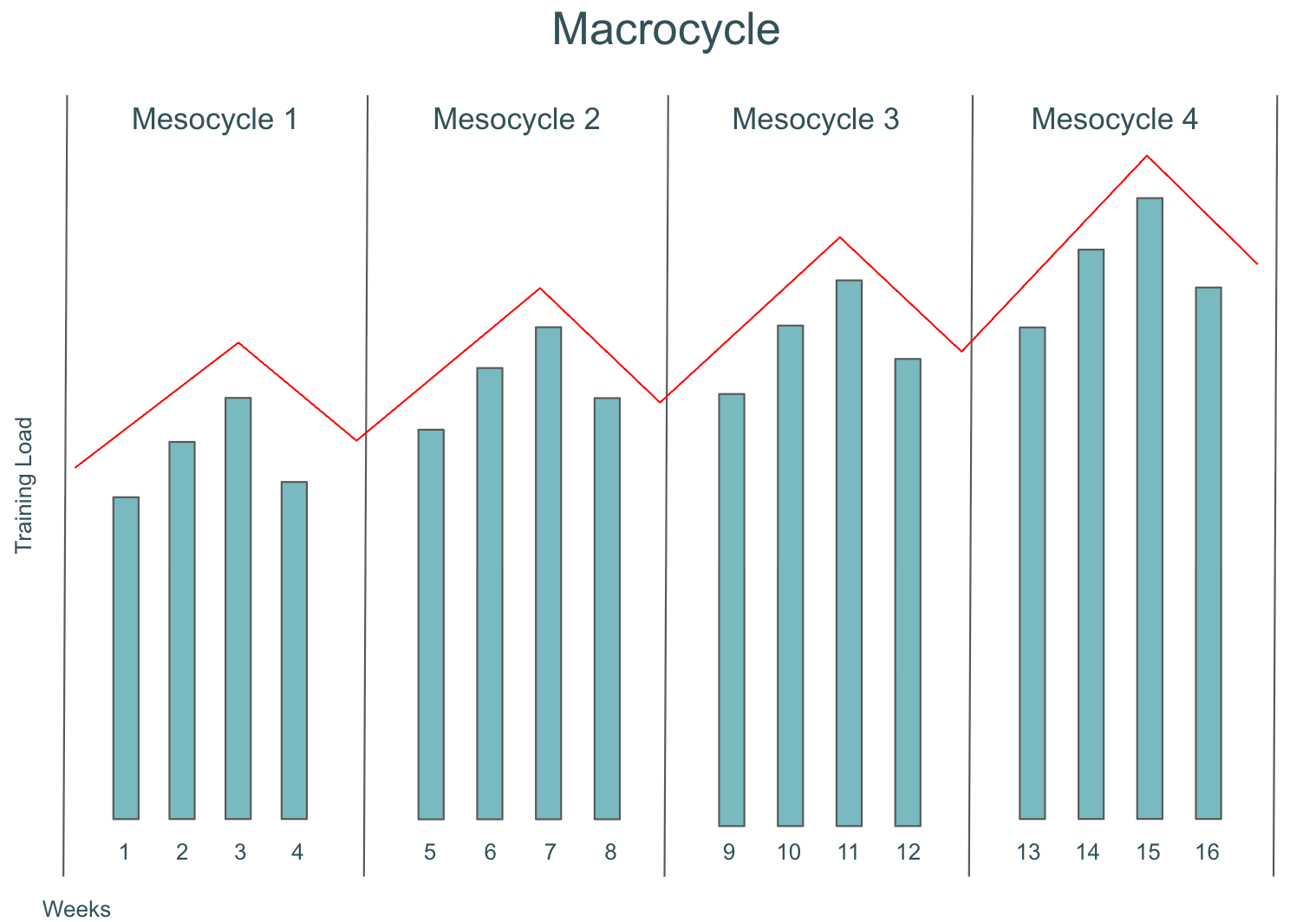
The rotation through these different cycles is generally referred to as “periodization.” While the classic periodization fits the cycle described above, some training programs focus on “block” periodization, where there is more granularity in focus across the weeks, i.e. specific weeks spent on threshold, VO₂max, or race-specific speed.
Likewise, these cycles hold for strength training, where linear, undulating, and block periodization frameworks are chosen based on the athlete’s skill level. While the “classic” ( linear) periodization described above is standard across endurance and strength training programs due to its many decades of proven success, the rise of hyper-personalization in training may result in more athletes trying variations of training to find a framework that works best for their physiology and lifestyle.
Ultimately, the goal with any periodized training is to ensure continuous adaption. For athletes, adaptation = improvement; if you do the same exact training every day, eventually your gains will stagnate. The goal is to build fitness, mitigate fatigue, and time peak fitness just in time for competition so that athletes show up rested and ready.
Endurance
Okay, so we’ve gone over the role of periodization in training plans, and why it’s important to shift training focus over time to maintain adaptations. But how do we actually train?
Let’s start with endurance. Fundamentally, endurance training is about modulating intensity, duration, and frequency over time to maximize adaptation while avoiding excessive fatigue or injury. If you’re into fitness spaces online, you may have seen the rise of “zone 2” training hype over the last several years. This is in part due to a large body of work showing that successful athletes tend to do a large portion of their training at lower intensities, which corresponds to “zone 2,” and a smaller but important portion at high intensity. [1, 2]
But let me back up: what are heart rate “zones?”
Heart Rate Zones
Heart rate zones measure the ranges of heartbeats per minute (bpm) that in turn reflect the intensity of exercise. The most common model, and the one I prefer, is the threshold-based 5-zone model pictured below.
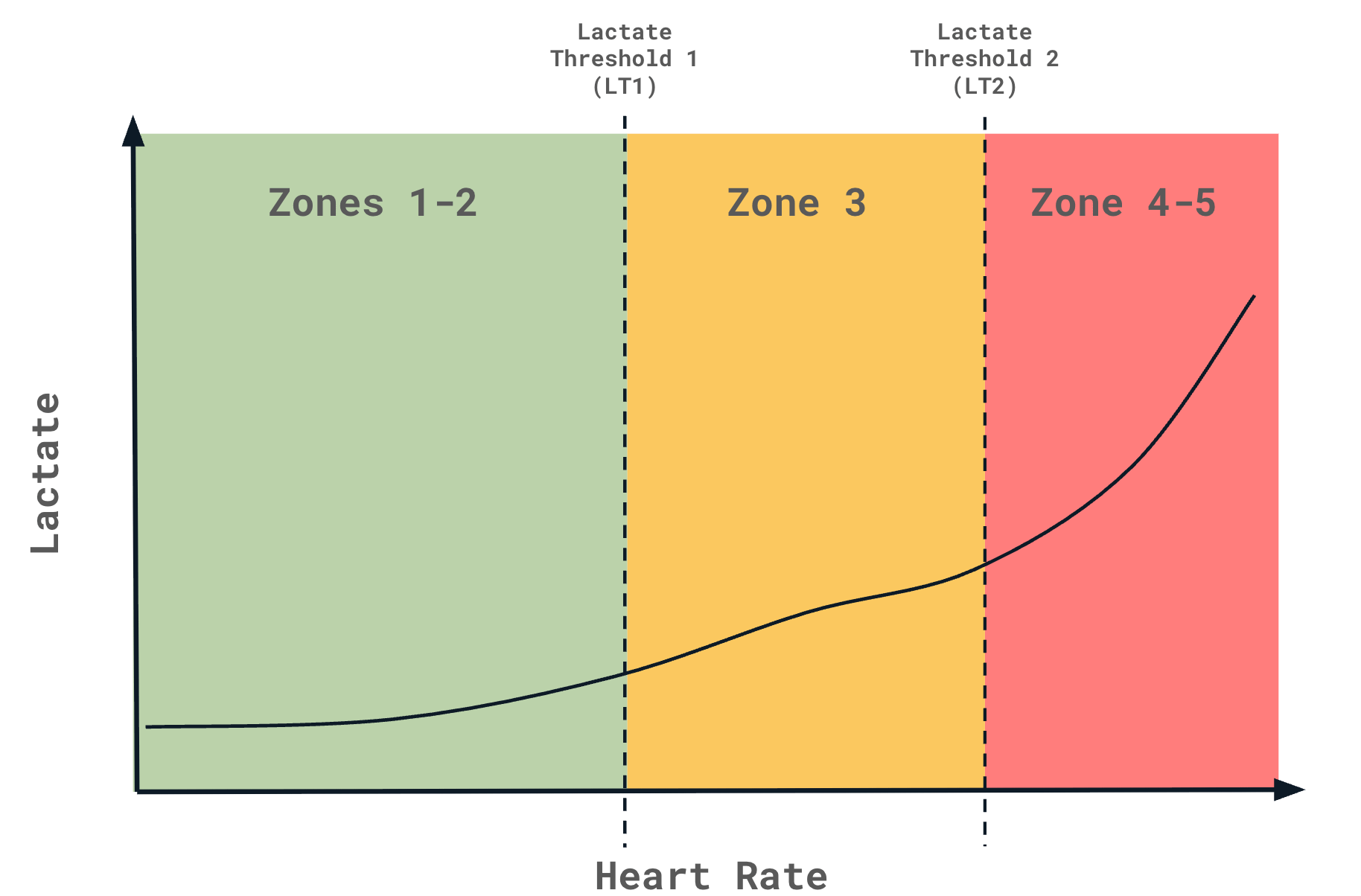
In this model, zones 1-2 correspond to easy, all-day efforts that an athlete could sustain for many hours at a time. Zone 2 in particular is where a huge amount of endurance training takes place, as it is low intensity enough to repeat often without risking extreme fatigue or injury, and high enough to stimulate aerobic adaptation.
At the top of zone 2 is what’s known as Lactate Threshold 1 (LT1), which corresponds to the first noticeable rise in blood lactate levels above the athlete’s baseline. Lactate is an important biomarker, as it is a byproduct of the body’s metabolism, and indicates that the primary source of fuel (carbohydrates) is being depleted as that the body is placed under increasing metabolic stress.
Below LT1, lactate production is balanced and breathing is controlled; above it, lactate production increases, but the rate of clearance is still outpacing production. Training below LT1 helps build an athlete’s aerobic base: scientifically, training in this zone increases mitochondrial density on a cellular level, encourages capillary development, and increases the heart’s efficiency. Put simply, training in this zone helps build what we casually call “endurance,” and builds out your stamina, giving you the ability to go on longer hikes, runs, bikes, etc. without fatigue.
Above LT1 is zone 3, which is often referred to as moderate or “steady state” work. In running, this roughly corresponds to marathon pace. At the top of this zone is lactate threshold 2 (LT2), which measures the point at which lactate production outpaces the body’s ability to clear it, resulting in lactate accumulation. LT2 is the boundary between hard sustainable work and very hard, unsustainable work. “Threshold training” refers to work done just before this point: training at or just below LT2 ultimately results in an increased capacity and a higher threshold, which allows an athlete to maintain a higher output for a longer period of time. In an imperfect analogy, zone 1-3 training increases your fuel economy, and LT2-focused work increases your horsepower.
Training above this threshold in zone 4 improves tolerance to lactate accumulation and increases an athlete’s ability to recover from surges or repeated hard efforts. Just above that, in zone 5, the focus is on developing VO₂max and anaerobic (or sprint) capacity.
Backing up again: just what the hell is VO₂max, and why does NASA track it as a requirement?
VO₂max
VO₂max, or maximal oxygen consumption, is the maximum amount of oxygen your body can use during intense exercise. Basically, the highest rate at which your body can take in oxygen, deliver it to your muscles, and use it to produce energy. It is usually measured in milliliters of oxygen per kilogram of body weight per minute (mL/kg/min). A higher VO₂max means a bigger aerobic “engine,” and the numeric value is often a predictor of endurance performance in running, cycling, rowing, and other sports. However, it is not the only thing that matters—two athletes can have the same VO₂max and still perform differently because of biomechanics, their respective lactate thresholds, fueling strategies, etc.
NASA tracks VO₂max as a requirement as it is a useful single-value metric that captures overall cardiovascular fitness. Ideally, astronauts won’t be operating in these higher heart rate zones—or anywhere close to their own VO₂max—during their mission. However, situations like emergency egress, or having to pick yourself up in a 300 lb spacesuit after a fall could result in a short period of high-intensity output where good “top end” cardiovascular fitness will be required.
In their current training, astronauts alternate between interval training and continuous steady-state exercise on a cycle ergomoter (CEVIS) or treadmill (T2). The CEVIS prescriptions are based on preflight VO₂max testing, with work rates prescribed around 70–100% of VO₂peak. T2 treadmill prescriptions are based on preflight training and heart-rate targets, around 70–100% of maximum heart rate. Again, only for only 25-30 minutes per session.
High Intensity Interval Workouts
With any good vehicle, you want a powerful engine, but you want good fuel economy, too. When it comes to the most effective type of endurance training, aggregate studies have shown that most athletes respond best to a polarized split:
Numerous descriptive studies of the training characteristics of nationally or internationally competitive endurance athletes training 10 to 13 times per week seem to converge on a typical intensity distribution in which about 80% of training sessions are performed at low intensity (2 mM blood lactate), with about 20% dominated by periods of high-intensity work, such as interval training at approx. 90% VO2max.
Of course, one caveat here is that most of these studies are focused on highly-trained, elite athletes who are often running, skiing, cycling, or rowing more than 15 hours per week. They physically cannot do all of their workouts at a high intensity without risking injury or extreme fatigue. The logic behind the 80/20 intensity split is simple: athletes should aim for a large volume of low- or moderate-intensity (zone 1-2, maybeeee some tempo work in zone 3) work to build their aerobic base, and then incorporate as much zone 4-5 work as they can to “raise the ceiling” while still being able to recover between sessions.
When athletes incorporate high-intensity work, however, they aren’t running out the door at a full sprint for as long as they can. Usually, this work is structured as intervals, often referred to high intensity interval training (HIIT), which has been adopted by many a Barry’s Bootcamp, Pilates, and Orange Theory alike as a way for everyday people to build fitness. Why? Because it’s effective!
Interval training allows athletes to accumulate much more time training near or above their race pace than they would otherwise be able to sustain in one single effort. Notably, HIIT-style training has been shown to be more effective at increasing VO₂max compared to equivalent time spent training at low or moderate intensities. However, HIIT alone is not enough for complete aerobic fitness, and as previously noted, this style of training does accumulate significant fatigue, as well as come with injury risks, especially for biomechanically stressful sports like running.
Finally, the 80/20 polarized training split is not some magic number. It is just what most elite athletes tend to do, and so it has been studied a lot. Like with periodization, there are other distributions of training that work for athletes across all sports. A focus on threshold training, high volume, high intensity, etc. all work for different people at different points in their training cycle, depending on their race goals, physiology, and training history. It takes some experimentation to figure out what works best.
Strength Training
The heart is, ultimately, just a muscle. And like endurance training, good strength training is not the same year-round—programs typically shift between periods focused on different aspects of strength in order to continue encouraging adaptation. For athletes, this looks the same as periodization, where programs will often start with a base-building phase and then get more race-specific into a given season. But what is strength training, if not just lifting heavy things up and putting them down?

In the most basic sense, strength training allows us to more effectively move through the world. Not only does lifting heavy things improve muscular strength, but it also: improves the nervous system’s ability to recruit muscle fibers and coordinate movement; strengthens tendons, ligaments, and other connective tissue to prevent injury; builds bone density; and improves movement economy which in turn reduces relative effort for a given motion.
Within strength training, progressive overload is the principle that training has to become gradually more challenging over time for the body to keep adapting. This should sound familiar: periodization and training distributions follow this same principle, which is to keep changing the stimulus on the body—with gradual loading increases—in order to encourage positive adaptation. Practically, this manifests in a slow increase in the number of reps, sets, or weight one is lifting each session. However, the exact amount and number of reps will depend on the goal of training:
Maximal Strength: The largest amount of force you can produce through movement, e.g., one-rep max deadlift. Typically trained through low rep, heavy loads, with longer rests.
Hypertrophy: A focus on increasing muscle size, which is very common in body building or aesthetics-driven training. Typically trained through moderate-to-high volume and progressive loads.
Power: The ability to produce a large amount of force, quickly. Typically trained through explosive movements, e.g., box jumps, or faster sets in conjunction with heavy Olympic-lift variants.
Muscular Endurance: Ability of a muscle or movement pattern to sustain repeated contractions over time. Common for runners, cyclists, and rowers. Typically trained through high reps with shorter rest.
Durability: Capacity of muscles, tendons, bones, and joints to tolerate repeated loading without injury or breakdown. Focus on gradual loading, unilateral (one-sided) work, calf/hip/core strength, and full-range controlled eccentric motion.
And that’s…kind of it. Anecdotally, I’ve been strength training for the past 15 years, and one thing I always hear from people is how boring it is. Unfortunately, the combination of routine and measured load increase through progressive overload is the name of the game, and there’s not really a good way around that.
What is interesting, however, is when we blend competing goals: put another way, how do we approach endurance and strength training together?
Concurrent Training
Or: hybrid training, perhaps? One major issue for endurance athletes—and a hot topic in online fitness spaces—is how to combine strength and endurance without one interfering with the other. This is called concurrent training in the literature, and hybrid training on the gram. Previous wisdom has argued that endurance work reduces or eliminates strength gains, especially when high running volume was combined with lifting. More recent reviews, however, suggest the effect is actually more manageable, as long as the athlete is training smart and fueling well.
Current best practice recommends that athletes put the most important session first when doubling up between endurance and strength work, and to ensure that they are getting adequate fuel (protein, carbohydrates) and rest in order to recover between sessions. That leads us into our next section…
Recovery
If you’ve made it this far, you can probably guess where this is going. I’ve mentioned repeatedly that training at maximum effort all the time is not actually the best approach for anyone, even elite athletes. Training puts the body under stress; recovery is when the adaptations actually take place.
In practical terms, recovery means restoring energy stores, repairing muscle and connective tissue, recalibrating the nervous system, reducing inflammation, and preparing the body to train again. There’s a lot of expensive, gimmicky products out there that tend to get all of the buzz (looking at you, Normatec) when really most of the benefit can be gleaned from adequate sleep and nutrition.
Sleep is an incredibly important recovery tool: it affects reaction time, mood, immune function, hormonal regulation, glycogen restoration, tissue repair, and learning; without enough sleep, the brain basically becomes worse at controlling the body. A lack of sleep increases perceived effort, and can limit the adaptation process, meaning that training is ultimately less effective. Athletes, like most people, generally require 7–9 hours of sleep a night, with many needing up to 10 hours during heavy training load weeks.
On the nutrition front, elite athletes are also consuming more carbohydrates and protein each day than the average person. Though it varies with training, endurance athletes will intake 5-10 g/kg/day of carbs—enough to replenish the glycogen stores in the body, support training, and sustain normal bodily function. Glycogen availability in the muscles influences fatigue, power output, and the recovery between sessions. The timing of the fueling matters, too—after a long or intense workout, athletes should aim for rapid carb intake in the first few hours, especially if training again the same day. Protein recommendations range from 1.2–2.0 g/kg/day, and will depend on the training needs, as well as whether or not the athlete is trying to build muscle.
Without proper fueling, the body will not have the tools necessary to support training, repair, and adaptation. Chronically poor fueling is even more serious, and can impair menstrual function, bone health, immune function, mood, and sleep; underfueling can cause serious conditions, like REDS, and lead to injuries like muscle strains and bone fractures. As a former anemic college rower, I can say that it is critical that athletes take fueling and recovery just as seriously as their training.
Conclusion
Training, ultimately, is simple: put the body under repeated, progressive stress to encourage adaptation. Microgravity exposure is the opposite of this—one long adaptation in the wrong direction. Future astronauts will have access to the state of the art biomedical sensors and health monitoring, but at the end of the day, the functional requirements for Mars surface operations are simple: can the crew carry out mission in a safe, efficient manner? We can measure their VO₂max and blood volume all we want, but ultimately, this test will be a practicum.
In my next article, I’ll review what we know about NASA’s real human health and performance requirements for future missions, and take a crack at designing a training plan for astronauts on their way to Mars.
Ad astra!
Further Reading
[1] CDC, “Adult Activity: An Overview,” Physical Activity Basics. Accessed: Jun. 17, 2026. [Online]. Available: https://www.cdc.gov/physical-activity-basics/guidelines/adults.html
[2] “WHO Physical activity Guidelines.” Accessed: Jun. 17, 2026. [Online]. Available: https://www.who.int/initiatives/behealthy/physical-activity
[3] M. Á. Galán-Rioja, J. M. Gonzalez-Ravé, F. González-Mohíno, and S. Seiler, “Training Periodization, Intensity Distribution, and Volume in Trained Cyclists: A Systematic Review,” Int J Sports Physiol Perform, vol. 18, no. 2, pp. 112–122, Feb. 2023, doi: 10.1123/ijspp.2022-0302.
[4] A. Casado, F. González-Mohíno, J. M. González-Ravé, and C. Foster, “Training Periodization, Methods, Intensity Distribution, and Volume in Highly Trained and Elite Distance Runners: A Systematic Review,” Int J Sports Physiol Perform, vol. 17, no. 6, pp. 820–833, Jun. 2022, doi: 10.1123/ijspp.2021-0435.
[5] T. Stöggl and B. Sperlich, “Polarized training has greater impact on key endurance variables than threshold, high intensity, or high volume training,” Front Physiol, vol. 5, p. 33, 2014, doi: 10.3389/fphys.2014.00033.
[6] P. B. Laursen and D. G. Jenkins, “The scientific basis for high-intensity interval training: optimising training programmes and maximising performance in highly trained endurance athletes,” Sports Med, vol. 32, no. 1, pp. 53–73, 2002, doi: 10.2165/00007256-200232010-00003.
[7] S. Seiler, “What is best practice for training intensity and duration distribution in endurance athletes?,” Int J Sports Physiol Perform, vol. 5, no. 3, pp. 276–291, Sep. 2010, doi: 10.1123/ijspp.5.3.276.
[8] D. Barranco-Gil, X. Muriel, A. Lucia, M. J. Joyner, C. A. DeSouza, and P. L. Valenzuela, “The Tour de France, also possible for mortals? A comparison of a recreational and a World Tour cyclist,” J Appl Physiol (1985), vol. 136, no. 2, pp. 432–436, Feb. 2024, doi: 10.1152/japplphysiol.00798.2023.
[9] G. Gallo et al., “The Weekly Periodization of Top 5 Tour de France General Classification Finishers: A Multiple Case Study,” Int J Sports Physiol Perform, vol. 18, no. 11, pp. 1313–1320, Nov. 2023, doi: 10.1123/ijspp.2023-0142.
[10] T. Althoff, E. Horvitz, R. W. White, and J. Zeitzer, “Harnessing the Web for Population-Scale Physiological Sensing: A Case Study of Sleep and Performance,” Feb. 25, 2017, arXiv: arXiv:1701.07083. doi: 10.48550/arXiv.1701.07083.
[11] J. M. Wilson, P. J. Marin, M. R. Rhea, S. M. C. Wilson, J. P. Loenneke, and J. C. Anderson, “Concurrent training: a meta-analysis examining interference of aerobic and resistance exercises,” J Strength Cond Res, vol. 26, no. 8, pp. 2293–2307, Aug. 2012, doi: 10.1519/JSC.0b013e31823a3e2d.